Allison Austin

Contact: amaustin [at] ucdavis.edu
GitHub: allisonaustin
Google Scholar
CV
[2026.07] Started FCSI internship at Fermi National Accelerator Laboratory
[2026.07] Presented work at ACM BCB in Rende, Italy
[2026.06] Presented work at ISC-HPC in Hamburg, Germany
[2026.05] My ALCF internship project, "Interactive Visual Analytics for Generating and Exploring LLM-Predicted Protein-Protein Interactions" was accepted to ACM BCB 2026
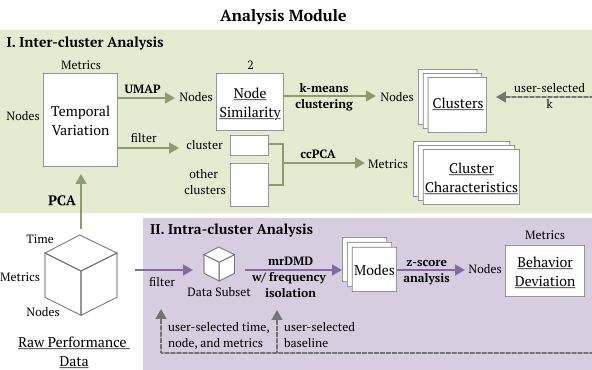
[2026.03] Our paper "Understanding Large-Scale HPC System Behavior Through Cluster-Based Visual Analytics" has been accepted to ISC 2026
[2025.06] Started internship with the CELS group at Argonne National Laboratory
[2023.11] Presented work at the International Semantic Web Conference in Athens, Greece
[2023.09] Joined the VIDI Group at UC Davis as a PhD student in Fall '23
Theme by orderedlist
Hello! I'm PhD student at the University of California, Davis advised by Dr. Kwan-Liu Ma at the VIDI Labs. I previously worked with Dr. Bo Fu in the D2 Lab at California State University, Long Beach.
I'm currently interested in applications of visual analytics for understanding complex algorithms and machine learning models to improve monitoring and usage of high-performance computing (HPC) systems.
On-going Projects
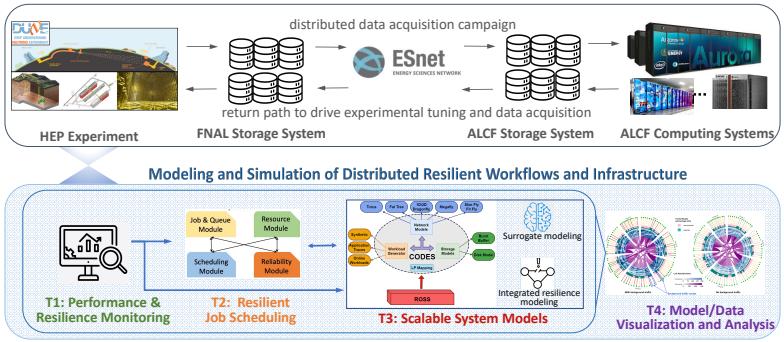
Visualizing Distributed Resilient Workflows and Infrastructure
Modern High-Performance Computing (HPC) infrastructures supporting large-scale scientific experiments and High Energy Physics (HEP) workflows generate massive volumes of complex telemetry and batch queue data. This project focuses on designing scalable visual analytics systems and interpretable machine learning frameworks to monitor, diagnose, and predict infrastructure and workflow performance across federated HPC environments.
Publications
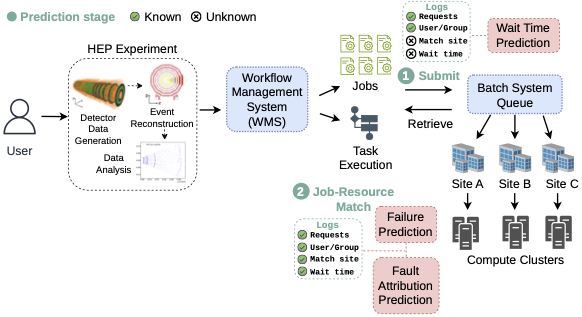
Under Review
Allison Austin, Logan Tang, Justin Mueller, Andrew Norman, Kwan-Liu Ma
Past Projects
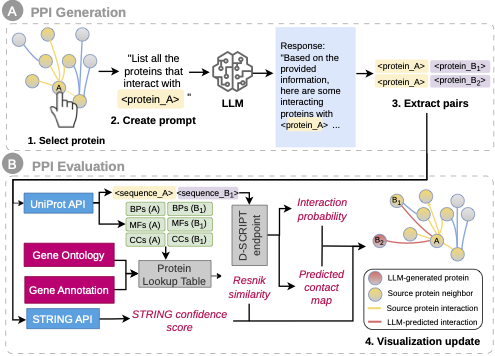
Visual Analytics for Generating and Evaluating Protein-Protein Interactions
Molecular data has been widely used to enrich visual representations of protein-protein interaction (PPI) networks, and has been expanded to support large-language models (LLMs) for various tasks (e.g. protein generation, interaction prediction). This project explores visualization techniques for generation and evaluation of PPIs that originate from LLMs.
Visualizing Elastic Depths for Detecting Anomalies in Functional Time Series Data
Applying an interactive visualization layer to Functional Data Analysis (FDA) techniques that decouple phase and amplitude variations in high-dimensional time series curves. [code]
Transformers for Failure Prediction in High-Performance Computing System Logs
Exploring transformer-based architectures (GPT and LogBERT) for online anomaly detection and failure prediction in HPC system log sequences. We evaluate model performance across large-scale time-series log datasets from LANL (System 20) and LLNL (BlueGene/L) using probabilistic inference techniques and custom attention mechanism variations, including Additive Attention and Hierarchical Attention Networks (HAN). [paper][code]